WHY BAMBOO IS ONE OF NATURE'S GREATEST BUILDING MATERIALS
From fishing rafts drifting across the Andaman Sea to Forest Elephant Resort
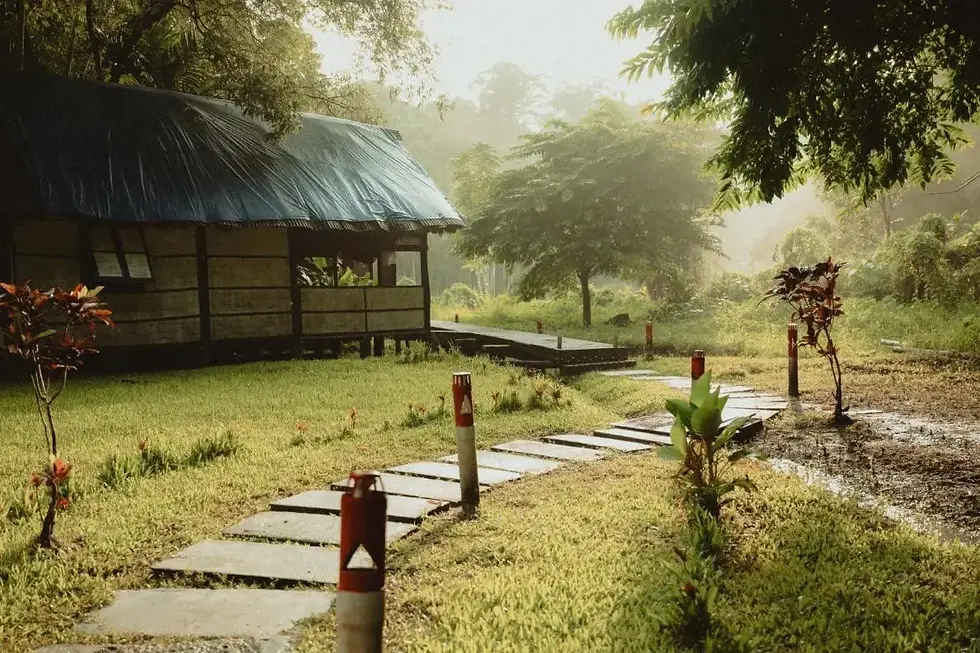
When you walk around Forest Elephant Resort, you might notice something before anything else: bamboo is everywhere.
It forms part of the buildings, creates natural textures and helps the resort sit comfortably within the tropical surroundings of Havelock Island.
But some of the bamboo has a story that goes much further than the resort itself.
Some of the bamboo used at Forest Elephant began its journey as part of fishing rafts that drifted across the Andaman Sea from Myanmar.
Local fishermen would sometimes come across these rafts offshore, tow them back to Havelock Island and sell the bamboo to us.
What was once a temporary offshore fishing station became a building material.
And what might otherwise have been left to the sea was given a second life.
This is one of the reasons we love bamboo.
BAMBOO: A MATERIAL THAT GROWS

Long before sustainability became a fashionable word in tourism, bamboo was being used by communities around the world to build homes, bridges, boats, furniture and everyday objects.
And there is a good reason.
Bamboo is remarkably versatile.
Unlike conventional timber, which comes from trees that can take many years or decades to mature, bamboo is a grass that can grow remarkably quickly. Once established, many species can regenerate from their existing root systems rather than needing to be replanted after every harvest.
That makes bamboo an exceptionally interesting material for sustainable construction when it is grown, harvested, treated and used responsibly.
It combines strength, flexibility and relatively low weight with the ability to regenerate.
In other words:
Nature designed an extraordinary building material long before architects did.
STRONGER THAN IT LOOKS
Walk past a bamboo building and it is easy to think of bamboo as something delicate.
But appearances can be deceptive.
Bamboo has a naturally strong tubular structure. The hollow sections and nodes along the stem help give it strength while keeping the material relatively light.
This combination of strength and flexibility has made bamboo useful in construction throughout Asia for centuries.
It can be used for structural elements, walls, screens, roofs, furniture and decorative details.
And in a tropical environment like the Andaman Islands, bamboo has another advantage:
It looks like it belongs here.
WHY BAMBOO MAKES SENSE IN THE ANDAMAN ISLANDS
The Andaman Islands are defined by nature.
Dense tropical forests, coconut palms, beaches, mangroves and the surrounding sea are what make the islands so special.
For a nature resort in Havelock Island, it makes sense for the buildings to reflect that environment rather than trying to dominate it.
Bamboo has a natural warmth and texture that sits comfortably among tropical vegetation.
It doesn't need to pretend to be something else.
It simply looks at home.
And when you stay in a bamboo structure surrounded by trees, you experience something quite different from staying inside a conventional concrete building.
You become more aware of the environment around you.
You hear the rain.
You notice the breeze.
You see the changing light.
You feel more connected to the landscape.
THE FISHING RAFTS THAT FOUND A SECOND LIFE

Perhaps our favourite part of the bamboo story at Forest Elephant is where some of it came from.
The bamboo wasn't originally intended to become part of a resort.
It had already had a life at sea.
Fishermen from Myanmar traditionally used bamboo rafts as temporary offshore fishing stations, allowing them to spend time fishing away from the coast during the fishing season.
When their fishing season was finished, the rafts could be cut loose.
Some eventually drifted across the waters of the Bay of Bengal and Andaman Sea.
Local fishermen around Havelock would occasionally come across these unusual floating structures offshore.
Rather than letting them disappear, they would tow them back to the island.
And they eventually found their way to Forest Elephant.
So when you see bamboo at the resort, you're not necessarily looking at a newly purchased building material.
Some of it has already crossed an ocean.
It has been part of a fishing tradition, travelled with the currents, been rescued by local fishermen and eventually become part of a home for travellers visiting the Andaman Islands.
We think that's a pretty good example of giving something a second life.
SUSTAINABILITY IS OFTEN ABOUT USING WHAT ALREADY EXISTS
We often think of sustainable tourism as being about new technology.
Solar panels.
Electric vehicles.
Water-saving systems.
Energy-efficient appliances.
All of these can be important.
But sustainability can also be much simpler:
Use something that already exists.
Give it another purpose.
Repair rather than replace.
Reuse rather than discard.
Buy locally when possible.
Make things last.
The bamboo at Forest Elephant is an example of this approach.
Rather than seeing an old fishing raft simply as waste, its material value could be recognised and reused.
BAMBOO AND THE IDEA OF SLOW TRAVEL

There is another reason bamboo feels right for Forest Elephant.
It encourages a different kind of holiday.
The Andaman Islands aren't somewhere you need to rush through.
You can walk to the beach.
Sit beneath the trees.
Listen to the birds.
Watch the rain.
Swim in the sea.
Eat slowly.
And simply enjoy being somewhere surrounded by nature.
This is the essence of slow travel in the Andaman Islands.
And bamboo fits naturally into that philosophy.
It reminds us that good things don't always need to be made quickly, replaced frequently or shipped halfway around the world.
Sometimes the best solution is already around us.
BAMBOO ISN'T MAGIC — RESPONSIBLE USE MATTERS
Of course, bamboo isn't automatically sustainable simply because it is bamboo.
As with any natural material, sustainability depends on where it comes from, how it is harvested, how it is transported, how it is treated and how long the finished product lasts.
Poorly managed bamboo production can still have environmental consequences.
But when bamboo is responsibly sourced, properly treated and used to create durable structures, it can be an excellent renewable building material.
That distinction is important.
Sustainability isn't about finding one perfect material.
It's about making thoughtful choices.
BUILDING WITH THE LANDSCAPE, NOT AGAINST IT
One of the things we value about bamboo construction is the way it allows buildings to feel connected to their surroundings.
At Forest Elephant Resort, we don't want guests to feel as though they've arrived somewhere that could be anywhere in the world.
You are on Havelock Island.
You should be able to feel it.
The tropical climate.
The vegetation.
The sounds.
The rain.
The breeze.
The occasional gecko.
The changing light.
The bamboo.
All of these things are part of the experience.
A DIFFERENT KIND OF LUXURY
Modern travel often defines luxury through more:
More space.
More air conditioning.
More technology.
More facilities.
But perhaps there is another kind of luxury.
Less.
Less noise.
Less rushing.
Less concrete.
Less unnecessary consumption.
More nature.
More time.
More connection.
More appreciation for the materials around you.
For us, that is part of what an eco resort in Havelock Island can offer.
VISIT THE ANDAMAN ISLANDS. LEAVE SOMETHING BEHIND.
Not rubbish, of course.
But perhaps a lighter footprint.
When you visit the Andaman Islands, choose accommodation that respects its surroundings.
Support local businesses.
Use resources thoughtfully.
Avoid unnecessary plastic.
Respect the forests and beaches.
Protect the marine environment.
And take the time to understand the place you're visiting.
Because tourism and nature don't have to be opposing forces.
When done thoughtfully, tourism can help people appreciate why these extraordinary islands are worth protecting.
COME AND EXPERIENCE THE STORY
Forest Elephant Resort is tucked away in the natural surroundings of Kalapathar on Havelock Island, where forest, paddy fields and the sea form part of everyday life.
Our bamboo isn't simply decoration.
Some of it carries a remarkable history—from offshore fishing stations in Myanmar, across the sea, to Havelock Island and eventually into the buildings of Forest Elephant.
It has already travelled farther than most of our guests.
And now it has somewhere to stay.
Perhaps you should too.
FOREST ELEPHANT RESORT
Kalapathar, Havelock Island (Swaraj Dweep), Andaman Islands
Come for the island.Stay for the stories.Leave with a lighter footprint.